Jin Daily AI Trivia - NVIDIA Open-Sources PiD: Decode + Upscale in 1 Step
NVIDIA Spatial Intelligence Lab just open-sourced PiD, aka Pixel Diffusion Decoder.
Normally, image generation works like this:
Text -> latent denoising -> VAE decode -> low-res image -> Upscaler
Or in layman terms:
-> AI understands the text meaning and turns it into vectors / embeddings -> It generates a tiny blueprint structure through noise and denoising -> VAE decodes the blueprint step by step into meaningful pixels -> You get a small, low-res AI-generated image -> Then another AI model enhances it and upscales it into a full-size image
The bad part?
Slow output. Decoding takes multiple steps, and errors can carry over from the previous stage.
Soft details / blurry texture. That is why many diffusion images still have that “AI brush” feeling.
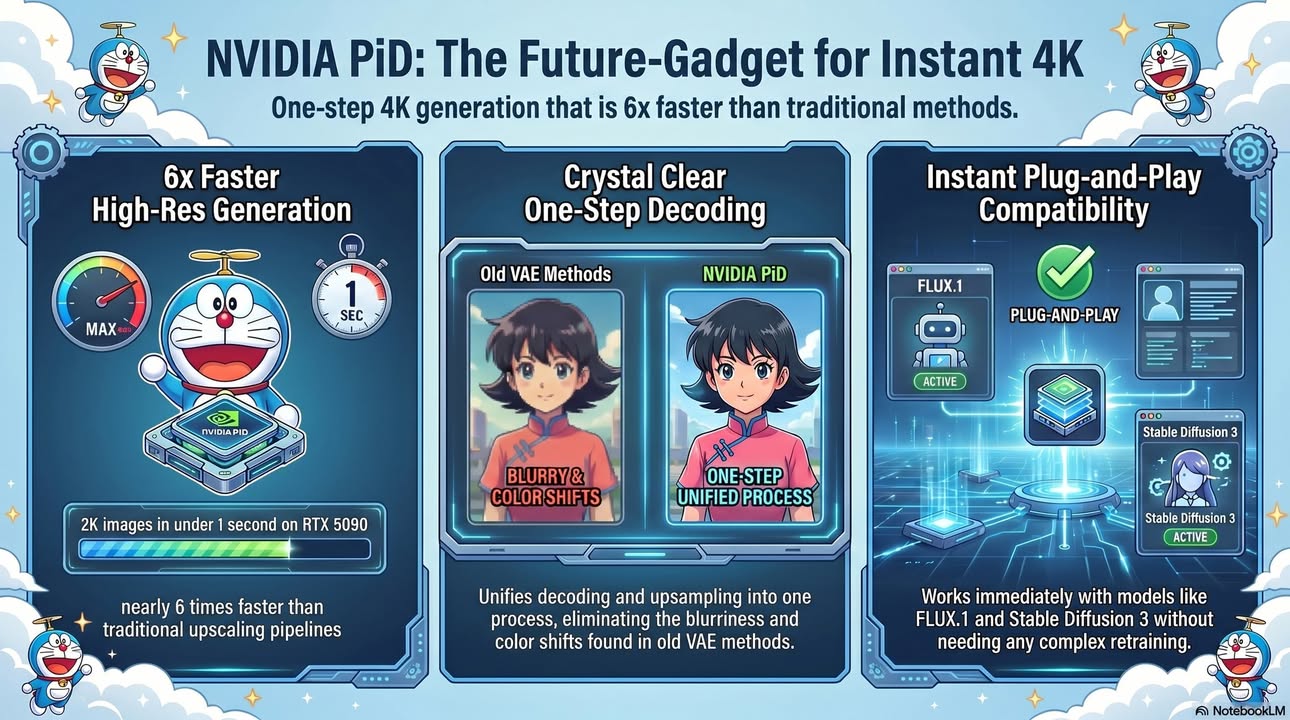
NVIDIA PiD basically combines these steps into one.
It is a conditional Pixel Diffusion Decoder.
It does not need to generate a small image first.
Instead, it plugs directly into the backend of image generation models like FLUX or SD3.
At the moment of decoding, it can directly output a 2K or even 4K ultra-high-resolution image in one go.
In the past, generating high-resolution images required dozens of rendering steps, slow like a slideshow.
PiD is around 6x faster and better.
Hope you learned something new today, see ya.