Jin Style Daily AI Trivia: Speech AI is getting super fast & mainstream 🎙️⚡
By Shee Tze Jin
Jin Style Daily AI Trivia: Speech AI is getting super fast & mainstream 🎙️⚡
For the past few years, many people have basically thought:
“Speech-to-text = Whisper.”
And fair enough — Whisper was a huge moment. It made multilingual transcription feel reliable, accessible, and easy to use.
But Whisper is still a 2022-era encoder-decoder Transformer model, and realtime voice AI has been moving very fast over the past few months. The race is no longer just about “who can transcribe audio accurately.” It is now about speed, streaming, dialect support, reasoning, and real interaction.
Today, the speech stack is getting crazier.
- Super-fast ASR models are becoming real
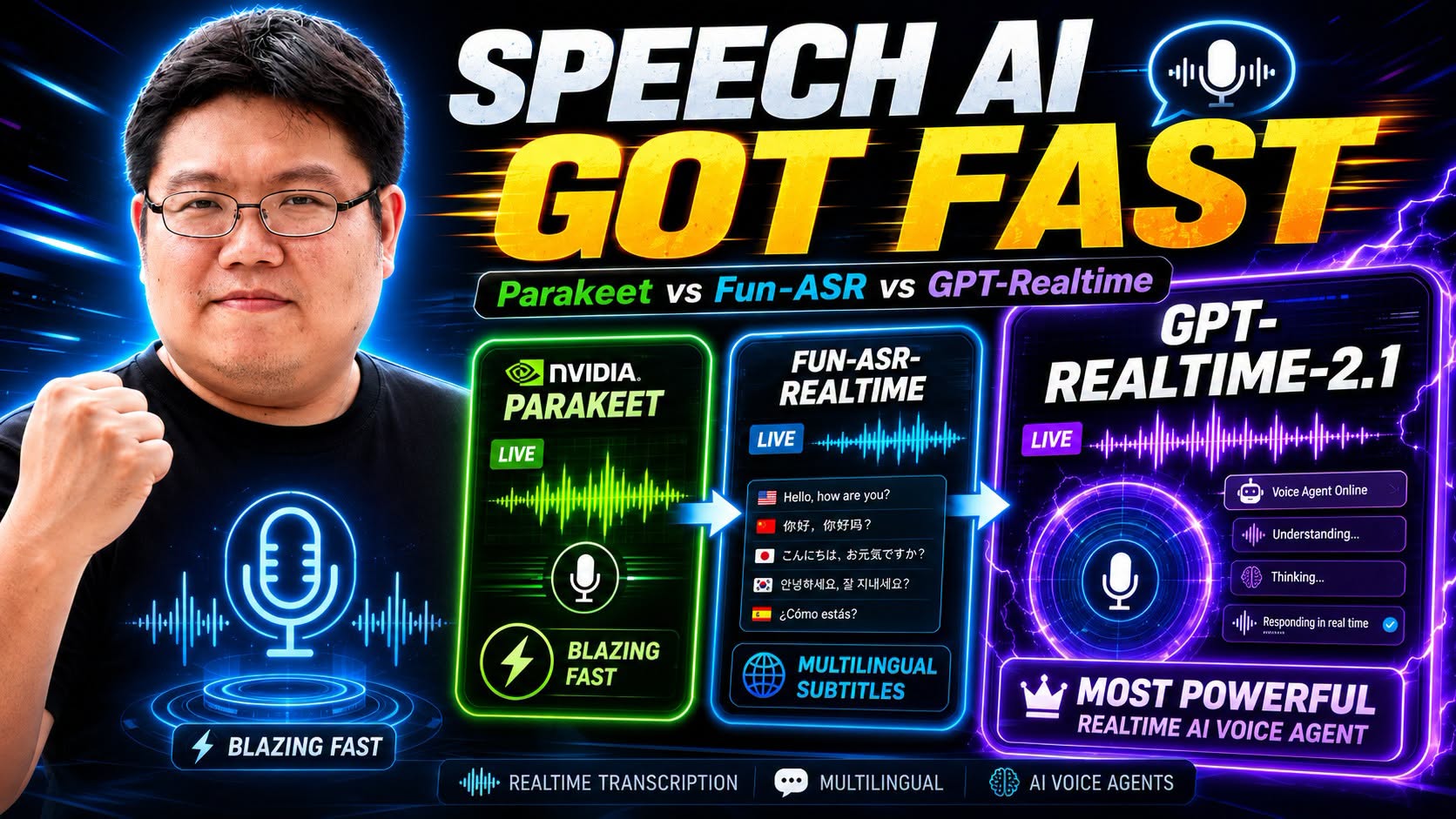
NVIDIA Parakeet has already become one of the new reference points for ultra-fast live speech-to-text, partly because of its architecture and non-Whisper-style design.
Now Qwen3 / Fun-ASR-Realtime is entering the same lane, but with a very strong focus on multilingual and regional speech support.
It supports 30+ languages, including Japanese, Korean, Vietnamese, Thai, Indonesian, Malay, Filipino, Hindi, Arabic, and major European languages — plus Chinese dialect and accent coverage.
The impressive part is not just the speed. Fun-ASR-Realtime is also designed to get close to the performance of its offline model, Fun-ASR-Flash. It can use context enhancement, hotwords, and previous conversation context to correct itself while streaming.
That is a big deal for live subtitles, meetings, livestreams, customer service, and any product that needs instant speech understanding. MediaStorm just use it in their latest live streaming event and it work so well, LIVE!
- Cloud realtime voice is no longer just “faster transcription”
The even crazier part is GPT-Realtime-2.1.
This is not just speech-to-text.
It is speech-to-speech, realtime reasoning, tool use, interruption handling, and voice-agent behavior in one model.
That means the model can listen, understand, think, speak back, and take action — all in a realtime conversation flow. It also supports text/audio input and output, image input, long context, configurable reasoning effort, and tool calling.
Yes, Realtime API…with REASONING and Tool CALLING!!
- Cost is dropping into mainstream-app territory
The other important part: cost is finally becoming reasonable.
Based on OpenAI’s audio-token pricing, a 30-minute voice conversation with gpt-realtime-2.1-mini can be roughly around $0.40 or 1.60 MYR.
And remember — this is not just basic transcription. This is realtime voice with reasoning and tool calling.
So in the future, “Hey AI, set a timer,” “summarize this meeting,” “call an API,” “check my calendar,” or “help me troubleshoot this machine” can actually become more reliable instead of the assistant just giving a hallucinated answer.
That is a big shift.
Voice is becoming the next UX layer.